I was joined today by Daniel Johnson, the leader of London School of Theology’s Theology and Worship programme.
A shorter article summarizing the key points of our conversation can be found on my Patheos Blog.
You can watch the full video here, or listen to the audio wherever you find your podcasts. Please like and subscribe wherever you are listening.
Edited Transcript
Introduction
Adrian Warnock: Well, hi there. I’m Adrian Warnock. Welcome to my studio, which is my car. I had thought on this hot day I could have air conditioning on. But if I do that, all you’re going to hear is wind blowing. So I’m suffering for the gospel here!
I’m here with Daniel Johnson. In the introduction to this live video I described you as an expert in theology and worship. I mean, what does that mean?
Daniel Johnson: Yeah, whenever somebody refers to me as an expert I feel like Daddy Pig from Peppa Pig saying “I’m a bit of an expert in these things.” But it does mean that I work for London School of Theology as programme leader for their Theology and Worship degree. I have done bits of academic work studying particularly the hymn tradition and things like that. So I’d like. I don’t know. I’d be very reluctant to call myself an expert. But I should probably know a little bit about this stuff.
Theology and Worship: Why They Belong Together
Adrian Warnock: People don’t always put theology and worship together, especially in the modern church. Have you got any thoughts on that?
Daniel Johnson: I have many thoughts on that.
Adrian Warnock: I thought you might, yes. We haven’t got time for your entire degree, but go on!
Daniel Johnson: My thoughts are that theology and worship are totally connected. The more we know about God through theology, the more that pours out in worship. I dabble. I’m a fairly slow-going writer, but I’ve dabbled.
A few of us at church joined with something called the 12 Song Challenge that Resound Worship run. For twelve months you have to write a worship song on a different theme. Some of those we’ve started using in our church. A few years ago I tried writing a bit more. More recently I’ve focused more on academic writing than worship writing. I’m particularly comfortable writing words. I think of myself more as a lyricist than a tunesmith.
Adrian Warnock: I think both are important, aren’t they. Often it’s the lyrics that survive and the tunes don’t.
Modern Worship Songs, Hymns, and Their Evolution
Adrian Warnock: A number of years ago when there was a whole rise of lots of modern worship songs, some of which were quite lightweight and chorusy. But increasingly some of them were basically recreating the hymn model. We think of songs like In Christ Alone. I’ve been privileged to interview both Stuart Townend and Keith Getty. They came from different wings of the church. But they came together and wrote what you cannot describe in any other way but as a modern hymn. So there are people writing hymns today.
But there was, I remember in my youth especially, a bit of antagonism between the old hymns and the new worship. Sometimes people would say, “Well, those hymns are set to boring old tunes.” Of course what we don’t realize is a lot of those boring old tunes were actually taken out of the gin places and such like by previous generations. So actually in some cases modernizing the music is exactly what needs to happen, but still keeping the old lyrics.
Daniel Johnson: Yeah, 100 percent. There’s a great quote from Graham Kendrick where he says that he grew up with the Beatles and the Baptist Hymn Book. That they were his two big influences, which actually you can see, I think, when I see people reworking hymns.
The History and Power of Amazing Grace
Daniel Johnson: A bit later on in this conversation I think we’re going to talk about Amazing Grace. I’ve written a chapter on this. It was set to loads of different tunes. It was only into the twentieth century that it was really consolidated with the tune New Britain, which everybody assumes it’s set to today.
I think, because I study hymns, some people sometimes assume that I wouldn’t want anybody messing with hymns. My problem is when people do it badly.
So for example, if I go to a stately home in the countryside, I don’t want everything there to be exactly as it was from the sixteenth century. They’ve put electricity in, they’ve maybe added Wi-Fi, they’ve added a café, maybe they’ve added a new wing to the building, they’ve added a lift. These are modern adaptations to something that is historic. The point being that those modern adaptations help you engage with the historic artefact or space. And I think with hymns, sometimes it feels like one of those really ugly extensions that you see on an old house, where you go, goodness, how did they get planning permission for that.
I think people are just actually taking something that has a bit more structural integrity and maybe needs a lift in it.
Adrian Warnock: The other thing sometimes people do is lift lines from individual people and use them. I discovered that recently. There’s quite a famous song that I think I had heard before. The line is, “Our sins are many, but His mercies are more.”
I don’t know if he did this deliberately or consciously. Or whether it’s like a lot of these things that have been passed on through different forms. That phrase, imagine my surprise, to find exactly word for word that phrase in a John Newton letter. Not one of his hymns, interestingly. He wrote loads of hymns, not just Amazing Grace. But actually in a letter. It’s a beautiful line.
Daniel Johnson: Yeah, I think he’s done some doctoral work on Spurgeon’s hymns. So I wouldn’t be surprised if he was more familiar with some of Newton’s stuff. You can take these phrases. Even this is Amazing Grace, this is amazing love. The idea that he can take these things. You’re almost tapping into that tradition.
John Newton: His Life and the Hymn Amazing Grace
Adrian Warnock: I did a little bit of work on this, looking at the phrase “amazing grace.” As far as I can tell, it didn’t really happen before that. So he may have even coined that phrase “amazing grace.” But for sure many people afterwards used it.
We will focus in on Amazing Grace a little bit, because I think it’s a good way of bridging between your passion for theology and worship and my passion for John Newton.
I got really gripped by John Newton last year when one of my pastors, gave a talk to mark the 300th anniversary of his birth. He said, go read the letters. And I got this passion to read them, and as I discovered, they’re a little bit hard to understand, as indeed even Spurgeon can be sometimes. But because I’m still old enough that my first Bible was King James, it was a bit easier for me, to be able to translate these a little into modern English. And often you don’t need to do a lot, just trying to make them accessible.
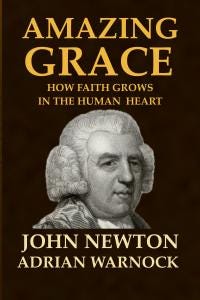
He wrote a lot of hymns, and some of his hymns made it into Spurgeon’s hymn book. But interestingly, Amazing Grace wasn’t one of them, and I can only assume that the tune wasn’t very good, or something. But what he did pick up on was loads of the language. I’ve got Logos Bible Software, and if you do a search of Spurgeon’s writings, there are many, many phrases that come directly out of that hymn. So he must have been aware of the hymn, but for whatever reason he didn’t include it in his hymn book.
Daniel Johnson: There is a bit of historical background to Amazing Grace. Newton was raised on not only Watts’s hymns but Watts’s catechism as well. For example, in Alas! and Did My Saviour Bleed there is the line, “amazing pity, grace unknown.” There is also a phrase in another of Watts’s hymns where he says “amazing grace that kept my breath.” Newton was raised on not only Watts’s hymns but Watts’s catechism as well. There is also a bit of context there with Spurgeon. It was either his dad or his grandfather who said that you’d pay him a penny for every hymn that he memorized, and so Spurgeon memorized hundreds of them.
Historians claim Bunyan was actually the first to describe God’s salvation as “amazing grace.”
Adrian Warnock: Amazing Grace didn’t really pick up in Britain. It was sung a lot over in the States.
Daniel Johnson: Somewhere on my shelf, just here, you can see this vast book, the Dictionary of Hymnology, from Dr Julian, that was published at the start of the twentieth century. It’s really scathing about Amazing Grace, it just says it’s not Newton’s best work.
Adrian Warnock: I just want to trace a little bit more about the origin of Amazing Grace. Then we’ll talk about how it kind of was rebirthed. But I think it’s just worth talking for a moment about John Newton. Amazing Grace very much summarizes his life story, doesn’t it?
Daniel Johnson: Yes, absolutely. He’s got a really incredible story. So in his teenage years he ended up going to sea with his father, which of course meant that he was involved in the slave trade. He kind of rose through the ranks. He kept absconding. Then, because he was in love with a young lady called Polly, he kept trying to get back to her. Eventually he kept getting press-ganged into stuff. He was such a nasty piece of work that eventually one of his ship captains just marooned him. He was actually sold as a slave for a point. There is, unfortunately, a lot of good evidence to suggest that he treated slaves very badly. He did all these things.
Then there’s a whole series of events. There was a storm at sea. He prays. It begins this sort of conversion experience. He starts to change. He comes back to Liverpool. He gets a job working in the harbour for a little bit. Eventually marries Polly. Then starts training for Christian ministry. He gets caught up in the eighteenth-century evangelical world. People like John Wesley and George Whitefield and others are part of this world. He settles in Olney.
He publishes this anonymous life story about his experience as a slave trader. Then he has both this very public ministry and this very private life. He does become one of the people who are involved quite early on in supporting the abolition movement.
Adrian Warnock: Although that’s quite a lot later in his life, isn’t it. I think one of the things you’re alluding to there is that many times today, if we’re honest, Today’s Christians are not particularly looking for the real reprobates to become believers. We look at somebody and say, “they’d make a good Christian,” and we target people on the basis, often, if we’re honest, that they’re like us. Are our churches really attracting the real reprobates? Are we going into prisons like we should be? Would somebody like John Newton have been welcomed in a church, let alone become a pastor.
Although of course you’ve got to understand one other thing, which is at the time what he was doing with the slave trade was completely welcomed, and considered normal by all these evangelical greats that we talk about now. Whitefield, Jonathan Edwards, even Wesley, they were not speaking out against the slave trade until later on. I mean Wesley did towards the end of his life, to be fair.
But it took a long time for the gospel to change John Newton, and it did change him, from being this really rough and ready man to being a gentle, compassionate pastor.
Daniel Johnson: There are a lot of the complexities around how we understand the legacies of those involved in the slave trade. The first abolitionists were enslaved peoples who protested rightly, who were chained at sea and had to eat their meals under duress to ensure they didn’t go on hunger strikes and things like that.
And so for people like many of these Christian heroes, particularly George Whitefield and Jonathan Edwards, it’s very complex to deal with their legacies, because they don’t seem to have any sort of repentance or awakening on this issue. John Newton became very clear, and he talks about how terrible he was as a slave trader.
Adrian Warnock: Near the end of his life, Newton said, “I am not what I ought to be, I am not what I want to be, I am not what I hope to be in another world; but still I am not what I once used to be, and by the grace of God I am what I am”
Mental Health, William Cowper, and Newton’s Pastoral Care
Amazing Grace was written initially by John Newton, and it was sung on the first of January, 1773, and that day was a very important day. It may well also have been the day that another great hymn was written, God Moves in a Mysterious Way. That hymn was written by John Newton’s friend William Cowper.
Now William Cowper had already had problems with mental health before, but he seemed to be slipping, and it may well be that he wrote it on the same day that Amazing Grace was released. And if he didn’t write it that same day, it was certainly in the few days or so before then. Maybe he started to feel he was slipping, and wrote the words about God moving in a mysterious way, hiding behind a frowning providence, in order that his wonders might be performed.
Its a wonderful hymn, a hymn that’s often helped people at great times of torment. I know for me it was one that I found helpful when I was at my lowest, as of course is Amazing Grace. One of the reasons Amazing Grace is so powerful is that you can sing it as a sort of celebration, but you can also sing it at a funeral, and people do. You can also sing it as in the sense of, well, my life’s been really tough, but somehow I know that in amongst it all God has not let my life end, he’s not let things fail for me, he’s been with me. “Amazing grace, how sweet the sound, that saved a wretch like me,” so there’s an understanding that we’re sinners, that we’re all struggling, and obviously it was easy for John Newton to write that.
Daniel Johnson: William Cowper had lived with very precarious mental health. He has this horrible mental breakdown and a suicide attempt. He’d gone to live with Newton for this respite, for this care. At the time they called it madness. His mind was just not a healthy thing. Newton very patiently tried to care for him. But Cowper never really recovers. He never comes out of this. The clouds never part. He’s just perpetually in this overcast world where his mind never recovers. These two hymns, written and released around about the same time, helped millions, perhaps. But they didn’t really help Cowper in the same way.
I have had personal experience of living with depression, so the reason I mention that is because I want to caveat any conversation around something as weighty as mental health with saying this isn’t, I’m not speaking with any sense of medical expertise here, I can speak from some personal experience, that there can be a danger among Christians that when we talk about mental health we treat it very spiritually.
Adrian Warnock: Yes, we often assume that mental health is a purely spiritual thing, or at least we have done, and unfortunately, you know, that’s just not true. We call it that at our peril, really, if we just think that it’s purely spiritual.
Going back to John Newton, in his day a lot of people would have seen mental health in those terms, as a spiritual problem, but he absolutely refused to do that with his friend, and he clearly understood there was a medical element. He even tried to find some doctors to see if something physical could be done to help his friend, but he always saw it as a sickness of the mind rather than a spiritual problem.
For the rest of his life, William Cowper was convinced he was damned, that he had been rejected by God. So he believed the gospel, but he didn’t believe it applied to himself. Right up until Cowper’s death, and even in his funeral sermon, John Newton was absolutely adamant, no, I’m absolutely certain that this guy is a Christian, and what he’s struggling with is a problem of the mind.
Daniel Johnson: I think the reason that hymns can be helpful for somebody with depression is because, like any experience, like any adversity, like any suffering, there is a spiritual dimension. If I broke my leg, that may affect me spiritually as I live with the pain or the frustration, or something like that.
If I had a long-term health condition, a physical health condition, that may impact my spiritual life. The way that people suffer, it can affect their souls as well as their hearts and minds. With depression, because it’s in the mind and it’s so close to our spiritual organs, if you like, the lines can get blurred.
Where hymns can be helpful is that they can reorientate the faith of our souls and cultivate our relationship with Christ through this suffering, and particularly where the hymn tradition is so helpful is that it can very often allow us to articulate that suffering in sort of psalm-like lament, and that can be missing a lot from modern worship, where there’s a lack of opportunity to really give voice to the kind of dark night of the soul.
And I think Newton is so good at knowing people’s kind of inner experience. He’s got this astonishing sense of how people work, because he’s so pastoral, because you see from his letters that he’s so deeply engaged in the lives of people. People go to him for advice because he’s wise, because he knows how people work and feel and tick, and how Christ can minister to those, he’s got that pastoral wisdom.
The Biopsychosocial-Spiritual Approach
Adrian Warnock: I think it’s maybe at this point worth talking about what I call the four-legged stool model here. Basically the four dimensions of our life. Biological, psychological, social, and spiritual.
This four-legged stool approach to suffering and healing is built on biological or medical evidence, understanding our thoughts or psychology, rebuilding our social world, and exploring spirituality.

I think we now know and understand that there is actually a biological element to mental illness, not for everyone that’s mentally distressed, but for many people. You can see sort of things like receptor imbalances in the brain, maybe changes in the brain, changes in the way the brain fires at certain times. If you put people in an MRI you can see which areas of the brain are lighting up. They didn’t understand that fully in Newton’s day. But Newton was quite interested Newton was quite interested in exploring physical options for treating his friend.
But he also seemed to distinguish the mind from the brain. Then of course there’s the social domain. At times Newton and his wife were not leaving Cowper’s side. So there’s the biopsychosocial, and yes, the spiritual. But for Cowper, at least, he was not able to get spiritual comfort at all.
For more on this model see these two videos or articles:
Daniel Johnson: That’s really complex, and it’s sort of almost this, he kind of goes to the perverse end of Calvinism. In this very, very flawed logic of, the kind of distorting mental picture of depression, convinces him that he is not elect, and it’s really tragic to see.
John Newton was a Calvinist, but he’s emphasizing this very warm, generous sufficiency of Christ. There’s a great quote from John Newton where he says that if you look at the kind of millions around the throne, there is more grace in Christ than all of them put together.
I think Newton, perhaps more than anyone that I’ve read, is so good at just this very warm delight in Jesus, and for Cowper to be unable to grasp that is so tragic, and it shows how sinister bad mental health can get, when the mind becomes this kind of iron gate that’s locked shut.
You mentioned the medical side. There were some interesting debates at the start of the eighteenth century around the smallpox vaccine. Some said to try and prevent disease meant you were trying to prevent God’s punishment or his purposes in maturing Christians. So for Newton to be advocating medical advances is a really significant thing. It’s a theological position, wherein he’s seeing God’s providence at work in the kind of development in society, in science and medicine
Socially, my own experience of depression was that it was so isolating. Your mind becomes this kind of cave that you feel locked in. Hymns speak to us, by virtue of the fact that other people can say words that you can resonate with. Somebody else knows what it’s like to be in a cave. They have also been able to find some sort of fellowship with Christ in this cave. That, for me, was a huge comfort.
The hymn Christ Is Mine Forevermore by City Alight says,
In minor days of minor tears and times of sorrow,
Darkness not yet understood,
Through the valley I must travel,
Though I see no earthly good,
But mine is hope in my redeemer.
It talks about the fact that we go through the dark night of the soul. I remember during Covid, Psalm 23, where it says that even I walk through the valley of the shadow of death, I will not fear, your rod and your staff, they comfort me. We can feel that when we walk through the valley that Christ is with us, and Christ of course can’t be in the wrong place, so therefore somehow we are not in the wrong place, even though this is not where we are wanting to be.
I don’t say any of this lightly. In the past year I’ve been to three funerals. Two of them were funerals of people who have succumbed to their mental health and taken their own lives. Seeing your GP, having therapy, having counsel, having friends. All of these things are necessary.
Adrian Warnock: I think that’s the thing, isn’t it, we need to address each of these issues. Maybe you need a pill, maybe on the biological side, or maybe you need to do a little bit more exercise, some people actually find that helps, or get some good sleep in, all sorts of other things on the physical side.
Psychological, yes, therapy, and that doesn’t have to be with a Christian, if you can’t find a good quality Christian therapist, most secular ones will operate in a way that’s sympathetic. You’ll find, surprisingly enough, that the wisdom that they have, that’s been studied, is often actually very congruent with what the Bible says anyway.
And then, socially, and this is challenging, isn’t it, because I think people do often want to, and even maybe need to, withdraw socially, but at the same time having some friends around you and knowing that they’re there for you, although that can be a help as well.
And yes, addressing the spiritual, but I think people move from one to the other and go, all I need is a pill and then I’ll be fine, it’s like, all I need is someone to pray for me and then I’ll be fine.
Daniel Johnson: Yeah, when my depression was at its worst, an older friend from church, the kind of friend where we wouldn’t have known each other if it wasn’t for church, went up to my wife and said, what can I do to help Daniel?
In his younger days he’d been there as well, in terms of really bad depression, and my wife just said, do you know, I think sometimes he’d just like to go to the pub with some friends.
And so I tease this friend now that some people get called by the Lord to go and be missionaries across the world, and God called him to go to the pub, and he was obedient to the voice of the Lord.
But there’s a lot to be said with that, because it became this group, and now, I think it’s eight years on, last Friday of every month a group of us from church go to the pub together, and it’s not a support group, it’s not about me or anything like that. Lots of people now come along who have no idea of the origins of this venture, but it came about because somebody in my church family wanted to reach out.
And other people have obviously helped in different ways, sometimes giving me a lift to the doctor’s, or asking if I’m taking my medication, other people have helped in practical ways with meals for the family. It takes a village.
But I think these four component parts are really helpful. John Newton, as a pastoral theologian, is so ahead of his time. He’s so wise in seeing how all of these things hold together, and how he, as I say, because he’s got this insight into the human condition, he’s able to articulate that through his hymns.
Amazing Grace as a hymn is fascinating, because so many people can resonate with. Yeah, I was the wretch that was saved. I know that feeling of how precious that grace appeared, and it’s Newton’s first-person testimony that becomes our first-person testimony, because he’s able to say things that resonate widely. I think it’s just incredible.
Adrian Warnock: We said before that initially it didn’t really take off in the UK. But what did happen. This is an irony, one of these wonderful divine ironies. The slave trader, who God gripped, turned around. The slaves in America started singing his hymn. They even added an extra verse, didn’t they?
Daniel Johnson: Yes, in the novel Uncle Tom’s Cabin they add this verse. “When we’ve been there ten thousand years.” That wasn’t by Newton. Amazing Grace became embraced both in the kind of second Great Awakening revival tradition. It was mainly in the States. It was brought back to the UK by Moody and Sankey.
This is why it’s a hymn of the world.
Then people like Mahalia Jackson recorded it, gospel singers in the ‘40s, and of course Aretha Franklin, her album Amazing Grace is the biggest-selling live gospel album. According to the Guinness Book of Records, there is no song that’s been recorded more times than Amazing Grace, in more varieties, but there is predominantly this one tune that it’s mainly sung to.
In 2015, there was a racially motivated mass shooting at a church in Charleston. Barack Obama starts spontaneously singing Amazing Grace. The whole congregation joins in. It’s just this incredible moment.
Reflections on Grace, Brokenness, and Ministry
There they were, nearly 250 years after the hymn was written, and in parts of the States being black could be a death sentence. The response to that was to sing this civil rights anthem, this song that has sustained the movement.
But of course, as you say, this divine irony, a hymn that was written by a slave trader. Those practices perpetuated these kind racist systems of thought and even theology and life. Then into that, the testimony of God’s grace, which was great enough to transform Newton from being this absolute reprobate into who he was in Christ. Then also a grace that even in the midst of a church grieving the murder of their pastor, they can turn to, this song and it’s just so powerful.
I think, when I engage with a lot of this stuff around the histories of evangelicalism and slavery and all these different things, I find there are some quarters of the Christian church that are very reluctant to talk about these legacies or these complexities.
Ultimately I do think it’s a gospel issue, and I think it comes from a lack of really understanding both the providence of God. Part of what fuelled abolitionism was the Christian faith, not all of it, but part of it.
But also enslaved peoples found the gospel in this song, despite it being given to them through oppression and subjugation. And now the fastest-growing church in the UK is the black Pentecostal church. In our nation, which exploited and dehumanized people through slavery, God is now using the descendants of those people to bring the gospel to our nation.
I look at that and say, well, of course, that’s how the kingdom of God works, because it doesn’t wait for us to become perfect.
Adrian Warnock: We say we believe in grace. But we often expect our leaders to be perfect. John Newton is a great example of somebody who wasn’t like that.
Daniel Johnson: There’s a lot of stuff going on, I think in modern churches, around questions of class background, education. I work in theological education, so I don’t of course think it’s a bad thing for ministers to be trained, or for worship leaders to be trained. John Newton is a great example of somebody who didn’t have that. Spurgeon is another one. So it’s not for everybody, but I think there does need to be a recognition that it’s God who calls, not our social structures or our institutions.
And where there is opportunity for churches, theological colleges, training programmes to support people and invest in them, and to kind of fan the flames of their gifting and their calling, then there’s a responsibility on the churches to ensure that there aren’t barriers for people getting in there. As I say, I am broadly in favour of bespoke theological education, I’ve worked in that sector for a decade.
Adrian Warnock: I’m sure your bosses would be glad to hear that.
Daniel Johnson: Yes, of course. But not because it makes somebody inherently superior or better, it’s just what we want to do is try and consolidate what God has already established, and what God has already put in place.
We’re not trying to create ministers, or create people that are ready for ministry, because, well, I mean, first of all, that’s silly to think that we can do what God has done, but also it comes from this very distorted view of Christian ministry and Christian priorities.
With John Newton, we can talk about this global legacy that he has with Amazing Grace, and things like that, but actually so much of his life was writing letters to individuals, or it was sat with Cowper, and by a very crude way of looking at it some might say that he completely wasted his time sitting around with a madman who wasn’t going to get better. But you know that’s not how the kingdom of God works, and that’s not how faithful living in the service of Christ works.
And so for those that are called to some sense of Christian vocation, they do so because they’re trophies of God’s grace, not because they have been to the right school, or they’ve got the right accent, or they wear the right clothes. When was the last time you went to a Christian conference and saw somebody preaching wearing a tracksuit? Because that’s what they wear.
I think there’s just this idea of expecting people to go to battle like David in Saul’s armour, is just nonsense. I mean, I’ve got this really weird situation in my own life where I was born and raised in the north-east, in Whitley Bay and North Shields, on the outskirts of Newcastle, but for a few years of my life I was a missionary kid in Papua New Guinea.
This means that I’ve lost my Geordie accent, so I sound kind of broadly middle English, I sound a bit posher than I am. I’ve watched home videos of me when I was a little kid, I’ve got this broad kind of Geordie, Geordie accent, but now I don’t hear many of those accents in and around the Christian circuit. I don’t hear many people who are from council estates in Liverpool or Bradford, and I think, well, why do churches get so excited about ministering to university students, as opposed to single mums?
Adrian Warnock: I think whether consciously or unconsciously we have an image in our mind of what the ideal Christian looks like, and it can almost be racist, actually, and oppressive.
We think slavery’s gone, but actually it hasn’t, it’s just gone underground, and it’s gone abroad. Even this T-shirt I’m wearing was probably, unfortunately, made by someone who may not have officially been called a slave, but doesn’t really have a free life, doesn’t really have the sort of life that we take for granted.
I think we have this idea that we somehow have to prove ourselves to be good enough to be a Christian,
If we go right back to the beginning of this interview, I mentioned that line about our sins are many but his mercies are more. It came out of this letter that John Newton wrote, and in that letter he said, look, you’ve got a job to do as a Christian. The most important part of your growth as a Christian is not becoming, oh look at me, aren’t I a good person. He says it’s actually understanding how evil your own heart is. He says something like, you know it a little bit, but you need to know it more.
Words of hope for us today by John Newton in Modern English

Imagine receiving these words as a message written just for you today by your friend and pastor, a certain John Newton.
We must understand how broken our hearts are. It’s not just the evil that is done by us, it’s also done to us. It’s also things like the physical health problems I went through, that devastated my life and devastated me emotionally. I was never given a label of a mental health diagnosis, for me it was the physical that destroyed me, and destroyed my social arenas and all of that. But that brokenness, that vulnerability.
And of course all this sounds like it’s destroying your hope. A lot of people in the secular world say that depression is all about not having real hope. It feels as though what Newton seems to be saying is it’s time to not have hope in ourselves, even in our fancy degrees, or the way we speak, or the way we look, or what race we are, or whatever, and actually to have very little hope in that, but truly begin to put our hope in God.
Daniel Johnson: Yeah, and I think the ways that we must understand this broadly and narrowly. This is the way that I understand the history of Britain, things like slavery. Again, I think it’s a gospel issue that Christians need to be willing to confront the evils that the church has done in the name of Christ.
I think not to comes from a lack of faith, because actually it’s kind of salvation by works. Let’s pretend that we weren’t as bad as all that, but what are you scared of?
If Christ really is who he claims to be, if Christ really has risen from the dead, if Christ really does have enough mercy, if there’s more mercy in Christ than there is sin in us, then why do we need to be scared of telling the truth about history, but also telling the truth about ourselves?
John Newton is such a striking example of how God can use the most unlikely person to be part of these multiple layers of God’s restorative, surprising grace. On the one hand he’s spending time with somebody like Cowper, or he’s writing these letters, but then he’s also counselling politicians to galvanize them in support of the abolition of the slave trade.
When William Wilberforce comes to him and says, I feel conflicted, because I feel called to the ministry, and yet I want to go into abolition, he says, well just do it, go and be the best Christian politician that you can be.
We’ve reduced all of that, in the kind of evangelical circles where I operate, into this, you’ve got to look right, you’ve got to sound right, you’ve got to dress right, you’ve got to have been to the right sort of schools.
There’s a lack of really dynamic trust in the grace of God in Christ. John Newton is evidence. He held to this his whole life, he held to the fact that his sins were many, but Christ’s mercy is more. Not to the point of being self-deprecating, or self-defeating, or this kind of morbid, almost like fetishized obsession with sin, this kind of self-flagellation. You don’t get this sense of self-hatred from John Newton.
He’s actually remarkably peaceful in himself, that he has done these things, but he’s kind of parked it. Christ is enough, and then because of that his ministry flows out of grace, rather than just his salvation.
Adrian Warnock: I think that’s right, and it’s the life as well, isn’t it. Maybe there’s been too much of a focus on, you become a Christian, you accept Jesus’s death on the cross, and on some level you accept that you sinned and all that, but then almost immediately you put that to one side and you work.
There isn’t a focus on, firstly, just how bad we actually are, but secondly, just how much Christ loves us. It reminds me a little bit of how Keller famously summarized the gospel, that the real message of the gospel is that you’re much worse than you think you are.
That’s basically what Newton’s letter said, you’re much worse than you think you are, and you’re much more broken than you think you are, and there’s much less that you can do for anyone else than you think you can. I mean, I guess Newton thought he could cure Cowper, but he couldn’t. There’s much less you can do, there’s going to be lots of failure.
This might feel like it’s driving away hope, but if it’s driving away false hope, that’s not a bad thing, actually. The other half of what Keller says is that you’re also much more loved than you think you possibly could be, and loved by a person who’s alive.
Our focus as Christians remarkably isn’t always enough on Christ, and not enough on the living Christ, and what he’s doing. He said he will build his church, he said he will build my life, he said he will complete the work he started in me, even when my body is failing, even when I make horrific mistakes, even when I treat people like I shouldn’t treat them, he’s still there, and he’s still alive.
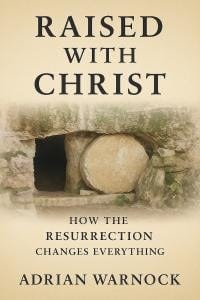
Daniel Johnson: So I’m going to plug your book, I found it when it came out in 2010, I found this so helpful, Raised with Christ, which I believe you’ve recently updated. At the time I remember I was being struck by how much, in Acts, the emphasis in the sermons was on Christ being risen from the dead, and that this is the culmination, the proof that Christ is who he says he is, and that Christ’s work is sufficient. Your book just landed for me at just the right time, for consolidating and really reframing all this.
You talk about being loved by a living person, I wrote a piece for Evangelicals Now over Easter about how much the risen Christ loves us. He goes to Mary and comforts her grief. He goes to Thomas and speaks truth to his doubts. He goes to Peter and forgives his sins. All of these things are because of the living Christ. And again, in Ephesians, that little phrase, that God in his great love has raised us with Christ, it’s the only time in Paul’s letters that phrase comes up, that the greatest revelation of God’s love comes to us through the risen Christ. I almost don’t want to say this, it sounds clumsy to say, but it’s the resurrection that shows more of God’s love than even the crucifixion does.
You mentioned before about hymn writing, I did an exercise with the 12 Song Challenge, we had to write, the exercise was, take a song and write the next part of it. So I took Watts’s When I Survey the Wondrous Cross and I wrote When I Survey the Empty Grave, which, we haven’t sung it at church. It was just this idea of taking the story the next step. What happens when I look at Christ through the lens of the empty tomb, not just Christ through the lens of the cross, and that Jesus is, that he’s not just alive, but that he loves us.
My wife’s been reading a book recently, Julian Hardyman’s book, called Jesus, Lover of My Soul, it’s all about the Song of Songs, and emphasizing this idea of Christ as the bridegroom, and Christ as the lover, and that that is the heavenly picture of the ascended Christ, the bridegroom who doesn’t just kind of tolerate us, the way, I love my kids, when they were babies, and I cleaned their nappies, but Christ delights in us.
I work as a musician, I’ve been a musician my whole life, and so I often get asked to play music at people’s weddings, when friends get married, it’s one of the great joys of my life, that people have asked me. It means that I’m always at the front of the church when the bride walks in, I can see not only the bride walking in, I can see the chump in a suit who gets to marry her. She always looks resplendent, and he always looks, and you think, goodness, he’s played a blinder there, but I also get to see just the absolute love in his eyes, because nobody else sees it, because they’re always looking at the back of the church as the bride walks in. You see this look on his face, like, goodness me, how lucky am I, and the idea that this is how the ascended, risen Christ looks at us.
And of course that doesn’t mean that he dismisses our sin, it doesn’t mean that he ignores it, it doesn’t mean that he doesn’t care about it, but it means that when we come to him, and he says, all that I have, I give to you, and all of our rubbish we give to Christ, and all of his righteousness and his love and his life he gives to us.
I have found, probably more than anyone else, John Newton has been helpful for me in centring on both the cosmic sufficiency of Christ and the personal sufficiency of Christ. I think very few people get that balance right, where you can either talk about Jesus in a personal way that almost reduces Christ. Sometimes people talk about this great cosmic, sovereign, reigning Christ, all of which is true, but the idea that actually Christ knows me or likes me or whatever just feels alien. John Newton, I have found, is so good at bringing both of these dimensions of Christ together. He is both the Christ who, when he’s risen, can say, all authority in heaven and earth has been given to me, and he’s the Christ who cooks breakfast for his disciples. It’s beautiful.
Adrian Warnock: It feels like that may be a good place to sort of draw to an end, but, this is just you and me and a few other people here, but do you think you could maybe let us see those words, When I Survey the Empty Tomb, could we share that with people and see what they think of it?
Daniel Johnson:
When I survey the empty grave,
From which the Prince of Glory rose,
I see his love,
His power to save,
and victory over vanquished foes.
The Lamb has crushed the serpent’s head,
Death’s bitter curse shall sting no more,
Christ rose triumphant from the dead
and opened wide salvation’s door.
See from his head, his hands, his feet,
the wounds that drive all doubt away,
here truth and love embrace
and greet the dawn of life’s eternal day.
Were the whole realm of nature mine,
that were an offering far too small,
love so amazing, so divine,
demands my soul, my life, my all.
Adrian Warnock: Beautiful. I think you’re right, so many of our hymns, and so many of our sermons, and so many of our summaries of the gospel forget the essential bit. I’m sorry, as crucial as the cross is, literally, the word crucial comes from crucifix, it’s not enough.
I recently updated the introduction of Raised with Christ, just to improve it a little bit. I deliberately put in a pithy line, which I didn’t have in there back in the day when I first wrote it, and it says, the cross alone could never save you.
Daniel Johnson: Paul just says we are absolutely to be pitied if Christ is still dead, we have absolutely backed the wrong horse if Christ is crucified and he is still dead. If somebody promised he would come back from the dead and didn’t, then we can’t trust anything he says.
It was part of that season, I was finding a lot of Tim Keller’s stuff really helpful, and his chapter on the resurrection in The Reason for God was so helpful. Evangelism in the Early Church, by Michael Green, was again just this emphasis that the creed of the church is that Jesus Christ is Lord, and we know that Jesus Christ is Lord because he rose from the dead.
Then Raised with Christ, coming into that season and consolidating those kind of personal and theological questions around how we see the resurrection of Christ, and for me the question was, well, what is the risen Christ like? Well, we see is someone whose mercy is more, that everything his disciples bring to him, in their own chaos of his death, and how they respond to that in all of these different ways, that his mercy is more, and that he’s able to heal and transform and renew each of them.
Adrian Warnock: So I would challenge the pastors watching this to do a bit of an audit. An audit of your sermons. Ask yourself how much resurrection is in that sermon. But also how much personal suffering and personal sin is in that sermon, how much do you expose? How much of that is in your sermons.
But also, for worship leaders, are your songs addressing some of the suffering and the desperation, as many do actually, and do they also, at least in that whole song set, at least one of those songs mention the resurrection. If it doesn’t, you’re in trouble.
I think it’s great that you, as a theological PhD person training the next generation of worship leaders and theologians, are willing to admit that you’ve struggled with depression.
So I want to thank you personally, and I know it’s not always possible or wise for people to share their stories, there are parts of my story that I don’t share publicly, but prayerfully consider how much you are willing to share.
One of the questions I plan on asking people, you’ve kind of already answered it is, what have you gone through that’s been particularly challenging, that you feel able to talk about. We will then talk about, as we did today, through a sort of biopsychosocial-spiritual lens,
Daniel Johnson: Yeah, absolutely. This trajectory that we see in the life of Joseph, that is mirrored in the Philippians hymn. He has come from the Father. He’s descended all the way down. Then he goes back up to God’s right hand. That is the life of the believer.
Adrian Warnock: Yeah, so he meets us in our struggles, in our sufferings, in our guilt, when we realize we’ve done things wrong and we don’t want to admit to it, but also raises us up.
Our sins are many, his mercy is more. That’s the kind of motto of our conversation. I think it might be a good place to end and let you get back to your day,. Thanks so much for joining me. We’ll keep in touch.
Daniel Johnson: Yeah, I’d love that.
Join me for my next live video in the app. Subscribe to keep up to date.