I very much enjoyed this conversation with veteran blogger, old friend, and John Newton enthusiast, Keith Plummer. This is an edited transcript of our conversation, which you can watch above or listen to wherever you find other podcasts.
A short article highlighting the key themes of our conversation is available on Patheos.
Links to the John Newton writings we refer to in our conversation can also be found below.
Edited Transcript
Adrian I’m Adrian Warnock and I’m here with my new friend Keith Plummer, although we’ve both been aware of each other online for a while, isn’t that right, Keith?
Keith That’s true, it goes back years. When I was blogging, you were blogging, you’re still blogging, I’m not, but we shared some links and crossovers years ago.
Adrian I don’t know if you ever saw my books at all back then, Keith, or
Keith I did see the book that you did on the resurrection, very much appreciated that.
Adrian So that was quite a while ago now. That’s good to hear, thank you. I’ve updated Raised With Christ more recently and now it’s available in an expanded form. One of the things I did to it most recently was added an afterword to it with a chapter by somebody that I’m sure almost every Christian today has heard of, Charles Spurgeon. He preached a sermon on the resurrection which had been very helpful to me when I was first writing.
But it also now has a chapter by somebody else who I think you are perhaps one of the most passionate modern followers of, a man called John Newton. I took one of his Messiah sermons, because he did this series of sermons, on the entire collection of fifty verses that Handel put to music. That’s in the back of that book now as well, updated into modern English to make it a bit easier for my readers.
We share a passion, don’t we, for John Newton. Before we get to that, can you just tell me a little bit about yourself and what you do now and how you got to be in that position?
Keith Sure. I am the Dean of the School of Bible and Theology at Cairn University, which is in Langhorne, Pennsylvania. I’ve been in this role since 2020.
I’ve been teaching at Cairn since 2010. Prior to that, I was in pastoral ministry in the Midwest in Illinois, and I was there for 18 years. So I got into teaching at Cairn through a friend who knew of my desire to do academia in a Christian context, and she put me in touch with some folks here, and that is what led to my being here.
I teach primarily in apologetics, and I also teach a course called Technology and Christian Discipleship, and that’s a little bit about how I arrived here.
Adrian So you’re interested in technology. I’ve, as you know, been very interested in John Newton and updating his writings into English and releasing that in a book form, and also on both my Substack and Patheos blog.
One of the things I came across, which I’m sure you’ve read, is a list of his pithy sayings, and I remember thinking as I read those that if he was alive today, there’s no question that he wouldn’t be on Twitter, and also probably on Substack because of all the letters he wrote, which he then, you know, was quite happy to make public. He liked the idea of actually publishing letters that he’d written, without revealing confidential details.
Keith Though I wonder what he would do with Twitter, because he was, he had an appreciation for, as you said, the letter. I think he liked long-form stuff, though he did have those pithy sayings. I think a lot of them were drawn out of the context of things that he had written.
Adrian Yeah, so maybe he’d be a bit more like say a John Piper who would write long-form articles and obviously sermons, and then other people would find the pithy quotes. But his writings are peppered with that.
Keith I think what’s happening today is oftentimes people who are preaching and doing public speaking are almost looking for the tweetable or postable bit, whereas with Newton, I think they just came from his expounding on things.
Adrian Now, some people might think, why is Adrian talking again about John Newton? I think you’d agree with me that he’s possibly the most important church history figure for right now in the 21st century that we can look at. I mean, obviously, outside of the Bible, and I really feel that quite strongly, and for a lot of different reasons, actually. I’d be interested to know if you would agree with that.
Keith Well, you know, superlatives and I don’t have the best of relationships, but I don’t know if I would say he’s the most, but I would certainly say that he is a very, very important one for our times.
Adrian Okay, maybe you’d say one of the most important! It is a funny thing this superlatives, for example Dr Martin Lloyd-Jones, when he was preaching, almost every time would say that this verse is the most important in the Bible. But the next week he’d proceed to preach on another verse and say the same thing. I think this was because it was what he had been studying. Perhaps I’m feeling that way about Newton partly because I have relatively recently discovered him.
I had another conversation with a Brit who’s also interested in John Newton, partly because of the link with Isaac Watts and hymns. He’s an expert in theology and worship, which I thought was quite a nice combination. He runs a course on Worship and Theology in one of the UK schools, London School of Theology. He and I talked about Newton too.
Watch my other Newton interview or read the transcript
One of the reasons why I think Newton is so important is that he shows us in his life the power of grace and the reach of grace. God can reach not just to the sort of people that we sometimes look at and say, “they’d make a good Christian.” Whatever the type of church we are a part of, we’ll often target people that look like us, that sound like us, that have a similar social status to the majority of people in the population of the church.
If somebody walks into a church who is a bit rough and ready, would they feel welcome? I think that even today, some sailors are a bit like that, and Newton was certainly no exception. When he was converted, he was certainly violent, aggressive, and rebellious against God. He not the kind of person you’d want to be around. In fact, even his fellow shipmates marooned him once. And, later on the way back to London other shipmates said that when a storm came, they thought he was a bit like Jonah, in that he was the one who had brought the punishment on them. So we both agreed in that interview, that perhaps somebody like Newton might not be actually even welcome in our churches today. I wonder what you think about that kind of question?
Keith Well, yeah, that’s a good question, and just to go along with some of the things that you were saying, in one of his writings, Newton said that God saved him just to show that he could.
“I am a living monument of mercy; and I trust that the word, ‘Because I live, you also will live’ (John 14:19, NIV), will carry me to the end. I am poor, weak, and foolish; but Jesus is wise, strong, and abounding in grace. He has given me a desire to entrust my all into his hands, and He will not disappoint the hope which he Himself has raised.”
Updated into modern English from Newton, J. and Cecil, R. (1824) The Works of John Newton. London: Hamilton, Adams & Co., p. 84.
He described himself as not only enjoying engaging in sinful behavior himself, but enticing others to join him in it. He received some kind of pleasure from it. I would hope that churches would accept someone like him, obviously doing significant, looking at the manifestation of his life. His life definitely bore the fruits of one who was genuinely regenerated, converted, and he loved Christ, and he knew the power of grace, and so he was a physician of the soul, and I think he was one who our churches would definitely benefit from. One of the things that I love about Newton is one of his sayings, he said,
“I am a riddle to myself, a heap of contradictions.” Read the context of this quote.
He knew that his heart was fallen, and he knew that his only hope was Christ, not only for forgiveness, but for change. I think he is a fitting pastor, but I think that, as your question kind of intimates, there are probably numerous churches who, knowing about his past, would be suspicious as to his fittingness for the role of pastor.
Adrian I think you’re right, and of course that was true in his day as well. It took a while before he was able to get his pastor after he’d decided he wanted to be one, there were some people responded, ”who is this guy? What’s he doing?”
And in some ways he was just kind of like the Apostle Paul in that his conversion was remarkable because of the sort of person he was before he was saved. I’m sure there are other examples, but he’s certainly one of the most well-known examples of a testimony of grace that’s so dramatic.
Keith Oh, yes, and when you know his life, and then you read or sing Amazing Grace, it just adds so much more depth to it, because he did not write those words in order to sound flowery and so forth. The more you know about the man, you realize that he lived a life in utter astonishment that God had extended his mercy and his kindness to him when he knew how undeserving he was. He said in one of his writings,
He is able to save to the uttermost, his blood speaks louder than all my sins, my soul is very sick, but my Physician is infallible.
Newton, J. and Cecil, R. (1824) The Works of John Newton. London: Hamilton, Adams & Co., pp. 179–180.
Adrian Oh, that’s so wonderful. There’s another line which I didn’t realize was his until quite recently, but he says, our sins they are many, but his mercies are more, which someone puts into a modern song. That phrase actually comes out of one of Newton’s letters. You can read the context for that quote here:
Words of hope for us today by John Newton in Modern English

Imagine receiving these words as a message written just for you today by your friend and pastor, a certain John Newton.
Often with Newton, if you then go back to the original, that is expounded and expanded, and you think actually I don’t want just that sentence, I want the whole paragraph, no wait, I want the whole letter.
Keith Yes, definitely.
Adrian You have quite an interesting relationship with Newton, because a lot of people dip in and out, maybe they’re vaguely aware that he wrote that hymn, and perhaps they’ve read a bit of a biography or such like, or maybe they’ve even dabbled in some of his letters. Talk to us a bit about your relationship with Newton, how you first heard about him, and what it was that you embarked on, and I believe finished.
Keith Sure. When I was in pastoral ministry in Illinois, there was a drummer, a member of one of the worship teams there, and I did some pastoral counseling when I was there, and he said, I think that you would really enjoy reading some of the letters of John Newton, and he recommended this abridged version of some of his letters, it was a small paperback, and I read it, and I thought this is good, but it didn’t really, really hit me as it did years later.
So Newton came in and out of my life. From there, several years passed, and I think it was, I might be getting the order wrong, but I came across a book called Extravagant Grace, which was written to discuss his view of sanctification, and that captivated me, and then I came across some of his work through Tim Keller and some of his writing, and then I wanted to really get into him.
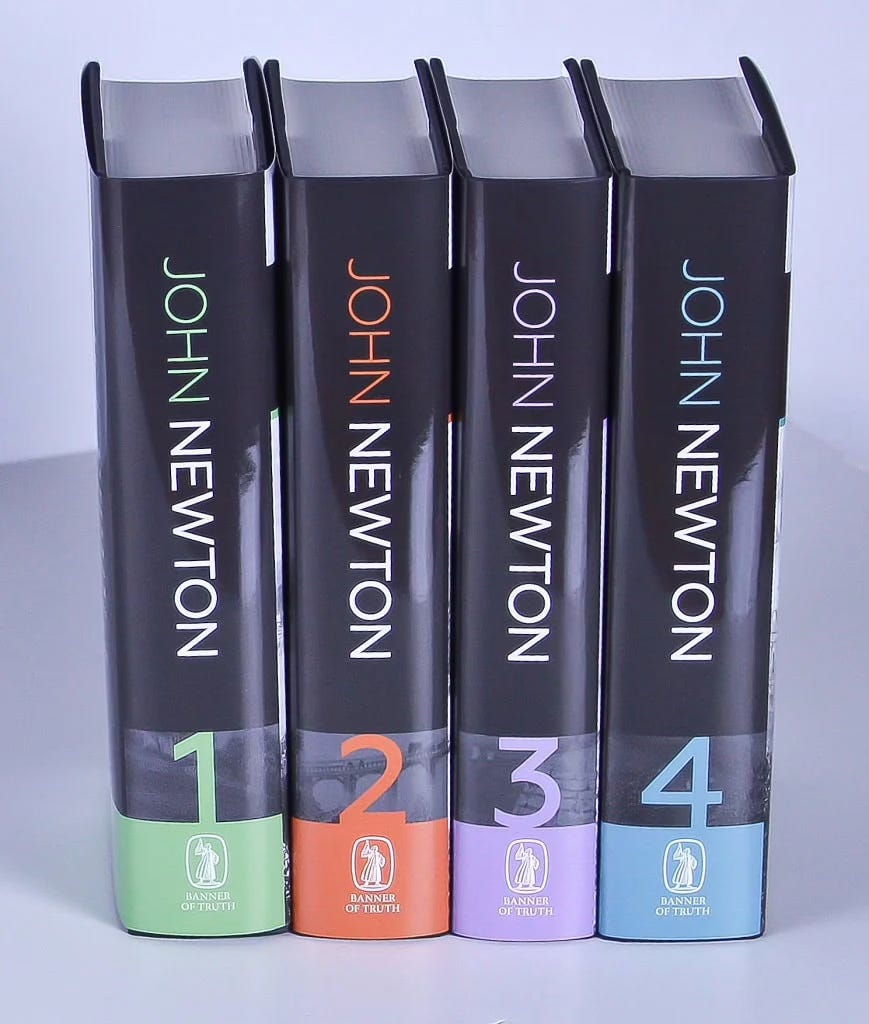
I remember years ago, reading or hearing John Piper say, you should try to find someone from the past who can serve as a mentor to you through their writings, and just immerse yourself in them, and I became really interested in Newton for a variety of reasons, and so there is a four volume set of the complete works of John Newton that Banner of Truth has put out, and my children got it for me. I don’t recall if it was Father’s Day or my birthday, I think it might have been Father’s Day.
I just set out, I said, I’m going to read a little bit of this every day, and it took me two years, and over that two year period, I read through the complete works, I continued to go back to them, I haven’t started from the beginning and gone through them all over again, but I do revisit them, and that was such a rich experience for me, and I have told people that I love John Newton because he helps me to better know my heart and the one who alone can remedy it. Those were two things that were just coming up as you read him.
Adrian So, you mentioned that there were several reasons why you liked him, even before you really dug in, and would you like to just elaborate what some of those were a little.
Keith Well, you’ve mentioned that he was just so grace-saturated, and his emphasis on the grace of God as our only hope and the only power for change was just so, so refreshing to me. I appreciated his honesty as a pastor, who he shared how it is that though he was preaching these great truths of the gospel, there were times where he felt, as he said, like a dog under the table, eating the crumbs of the food that he was serving up to other people. I liked the fact that he viewed pastoral work as being analogous in many respects to being a physician.
One of Newton’s favorite terms for Jesus was the great physician. He said about himself that he gained most of his experience by spending time with the sick:
“My course of study, like that of a surgeon, has principally consisted in walking the hospital.”
Newton, J., Richard Cecil (1824) The works of the John Newton. London: Hamilton, Adams & Co., p. 100.
He spent time with people who were suffering, and he gained from that a pastoral wisdom and knowledge that I thought was just so commendable and helpful. I appreciated his pastoral counsel largely through the ministry of letter writing.
Adrian There’s two things that stick out of what you’re saying, which I’ve also seen very much in the Newton that I’ve read, and I haven’t read all of it, unlike you. This is about his pastoral theory, his theology, but also his practice. The first is this idea that our hearts are really sinful and really deceitful and really evil. One of the biggest tasks you need to have as a Christian is to become more and more aware of just how sinful your heart is. This is not particularly modern messaging! You could see that as quite negative and condemnatory, and, oh dear, let’s get all self-introspective and focus in on ourselves and try and root sin out of ourselves, but he didn’t do that.
He was much aware that to actually deal with sin needs to be God’s job. The idea of knowing yourself was to see how beautiful and wonderful the grace of God. He was grace-satisfied, and grace, as you put it, saturates us.
Secondly, and this is something that we don’t always see in people that claim to be, preaching the doctrines of grace, he had this incredible compassion towards others and their suffering. He didn’t come to others in a pastoral setting and say, you’re a terrible sinner, you need to repent, and you need to understand how awful you are, in a harsh way. He came and met them in their place of suffering, and in their place of sorrow, and was incredibly compassionate towards the people he saw, both in terms of face-to-face and, as you say, in terms of his letters.
Keith Yes, because he saw, he recognized himself in others, and the sins that they were dealing with, the struggles that they were going through, at one point he uses this analogy of how foolish it would be if a blind man were to be miraculously restored to sight, and then he were to go and take a stick and beat other blind men for being blind.
“Those who claim to be Christians, and who believe in the doctrines of free grace, often act inconsistently with their own principles. They become angry at the flaws of others. A group of tourists fall into a pit. One of them gets a passer-by to lift him out. He should not be angry with the rest for falling in, nor because they are not yet out, like he is.
He did not pull himself out. Instead, then, of blaming them, he should show them compassion. He should avoid, of course, going down into their position again, and show how much better and happier he is out of the pit. We should take care that we do not make our profession of faith into an excuse for all other responsibilities. A man, truly enlightened, will no more despise others, than Bartimeus, after his own eyes were opened, would take a stick, and beat every blind man he met.”
Updated into modern English from Newton, J., Richard Cecil (1824) The works of the John Newton. London: Hamilton, Adams & Co., p. 105.
Adrian But, well, wouldn’t that be a good description of much preaching today, if we’re honest?
Keith Yes. People think today, if you focus upon the sinfulness of the heart, you are just going to be disparaging people. But Newton had this illustration once where he said that the Christian life is like the bass and the treble line of music, that simultaneously there is a bass line that consists of these low notes in terms of our awareness of our sin and our weakness and so forth.
But there’s a melody line that there is a simultaneous joy, even coexistent with the recognition of the sinfulness. And I think what we tend to do is we say, well, either we’re going to concentrate on the bass line or the melody line at the expense of the other. And Newton realized, no, these two coexist, and the knowledge of self is so necessary in order for grace to be properly appreciated.
Newton on the Treble and the Bass
And that’s one of the things that just really, really captivated me about him, in a way similar to how Calvin says that self-knowledge and knowledge of God are interrelated. You see that throughout Newton’s writing and his approach to pastoral ministry. He says that unless you know the gravity of the sickness, you cannot properly prize the physician.
Adrian Yeah, and I mean, using the medical model, I’m not sure if you’re aware of this, but I’m medically trained. Yeah, that’s right. But, you know, we were always taught that you have to get to the diagnosis first before you can provide the treatment.
And I fear that sometimes today we want to sort of offer a treatment to people, you know, and spiritually, we want to emphasize the love of God, you know, and that’s all great and wonderful. We want to be kind to people. We want to be compassionate.
We want to show them that they’re not alone and sit with them and all of these things. And of course, Newton did that, no less so than with Cowper (pronounced Cooper), and we’ll come on to that, I’m sure. But there’s also sort of unwillingness to actually help with the diagnosis sometimes, and a fear of perhaps not offending people.
That’s the one thing. So you see, you know, I guess you could call it emphasizing love and neglecting truth. But then there are others who do emphasize truth and want to proclaim the gospel to honor God, but don’t seem to be concerned about even being persuasive or winsome or, kind to people. They just want to get that message out and make sure everybody knows that they haven’t compromised.
Just recently, I was working on passage in James, and it came to me afresh, that we’re all subject to temptation, but it comes from ourselves. You know, it says no one should blame God, and I don’t think we do that too often today, but we certainly blame the devil for temptation, or we pretend that we’re immune from it.
God is not to blame for our sin
I think that’s where it becomes very dangerous. I even wonder whether that kind of superficial idea of if you’re a mature Christian, then you’ve got a heart that loves God, and therefore, you don’t have to really worry about sin, isn’t part of the thing that leads to complacency, naivety, and the vulnerability to great falls that we’ve seen all too often, unfortunately.
Keith Yeah. This is one of the things that he said. This is in a letter that he wrote to an associate:
You have one hard lesson to learn, that is, the evil of your own heart. You know something about it, but you must know more. The more we know about ourselves, the more we will prize and love Jesus and His salvation.
Read more about this in the following article:
Words of hope for us today by John Newton in Modern English
Imagine receiving these words as a message written just for you today by your friend and pastor, a certain John Newton.
Adrian That’s a really powerful piece of writing, isn’t it?
And I think maybe this is a point to just talk a little bit more specifically about Cowper. And one of the things that fascinates me as a psychiatrist, and also someone who served in pastoral leadership, and someone who’s gone through suffering, not mental illness, but physical illness. It was such significant physical illness at times that it certainly has had effects on my heart and mind. And there’s been nights I have wept into my pillow, and all night, and things like that. My world just collapsed around me.
So I’ve been in the low points. And even today, sometimes I get frustrated that I can’t really work. I can still talk, but I can’t talk all day, and I can’t work all day, and I can’t write all day. And there have been many months when I haven’t really been able to focus enough to have this kind of conversation when I’ve been at my sickest.
As a psychiatrist, we’re taught the bio-psycho-social model. We’re taught that when you think about a mental health problem, or indeed a physical health problem, that you need to apply not just the biological medical model, which says, “let’s find out what’s wrong with the body, and give a tablet, and fix it”.
We must also, look at the mind, and what we think about, counseling comes from that, and techniques like replacing negative thoughts with more positive ones. We also need to look at the social side, our relationships with other people, and the sense of purpose, structure, and routine.
All of those things can have a massive impact on our well-being. As a young psychiatrist, in the secular sense, we weren’t taught to then focus on the fourth element to this, the spiritual. I call it a four-legged stool now.
More about the biopsychosocial-spiritual model
One of the things that struck me in the way Newton handled Cowper, and you can perhaps speak to this a little bit more, is that he approached it as not merely a spiritual problem. In fact, he was quite clear that he thought this was an illness, and he even went to doctors, tried to get him some help. He tried to use the power of his friendship, and the friendship of others, and just trying to keep him safe by monitoring him and stopping him killing himself.
I would argue that he was quite ahead of his time in using, although he didn’t use those words, a biopsychosocial-spiritual model in his care of Cowper. Would you agree with that assessment, having read all those letters?
Keith I think so. You see such a beautiful friendship and such a care in his concern for William Cowper, taking time to write hymns with him, to try to get him to focus on the grace of God and to focus less upon himself. And it was taxing for him to invest this care that he did, but I think you’re right. He recognized that there were a variety of aspects that were involved, and it couldn’t be reduced to just one thing. So I do think he was ahead of his time.
Adrian And of course it was quite striking how things developed. There was this period of time when Cowper had been in a psychiatric hospital, but then he got out of that. He came into Newton’s orbit and decided to move to Olney to be with him, and for a while he was doing quite well. He was effectively functioning as an assistant pastor there. They were, as you say, writing some amazing hymns together.
Two of these hymns coincided. I’m about to use a superlative again, perhaps two of the best, or even maybe thebest hymns that have helped people at difficult times. Amazing Grace being one of them. As we spoke about when I chatted with the theologian from the UK, Barack Obama sung that famously, spontaneously after a mass shooting event. It gets used in these big national moments of grieving. I know for me personally, it was one of those songs that helped me when I was at my lowest point.
Amazing Grace was released by John Newton on the 1st of January 1773. All the historical evidence suggests that Cowper may have also actually written his own most helpful hymn for hard times on the same day, God Moves in a Mysterious Way, His Wonders to Perform. That should be right up there among other hymns that have helped people who are suffering. He certainly went to church in the morning, and listened to Amazing Grace being released. He possibly came home and wrote that hymn before chatting with Newton that afternoon, as they usually would.
But then something terrible happened that night. But what’s striking to me is that unfortunately those two hymns which have helped so many other people actually didn’t help Cowper. There was a terrible scene that evening when Cowper, collapsing into a severe depression tried to kill himself. Newton and his wife went to him. They had to stay with him. Somebody had to stay with him for a long time after that.
The sad thing is that after that moment, he never regained his full sanity and his faith. The first time Amazing Grace was sung was the last time he ever attended church. Cowper was convinced from that time on that he was reprobate or cursed by God. He believed the gospel, but he believed that God had damned him.
What’s really striking is that unlike many Ministers of the time who would have said this was spiritual problem, Newton was convinced that this was a sickness, much as many people would have said today. There’s a recognition today that religious thoughts can be a major part of someone’s mental distress. Mental illness can affect can change what someone thinks about God and how they feel about themselves. There can be a sense of false guilt. Newton somehow knew that and continued to be his friend for years. And then even when he moved to London, he continued to support him.
When Cowper died, in his funeral sermon, Newton said that he was convinced that this man was a Christian. Considering a lot of the views more common in those times was quite striking I think.
Keith Yeah. I’m so glad you raised that hymn. If anyone has not read those words or sung those words, I would strongly urge you to go online, look them up. That is one of, here, I’ll go superlative. That is one of my favorite hymns. It is so beautiful. I regret the fact that it is not sung or known more widely.
The truths that it conveys are beautifully expressed. And this is another thing that kind of goes back that, another thing that really captivated me about Newton is his conviction about the meticulous sovereignty of God and the goodness of God. And you think about some of those lines in Cowper’s song, the clouds you so much dread will drip with mercy on your head. I mean, it is a wonderful, wonderful piece of hymnody that I think the church is impoverished by having forgotten.
A modern tune for this ancient hymn
Adrian I think you’re right. And it’s got a remarkable history, actually, as well, that a lot of people are not familiar with. But there’s a remarkable incident in the life of the young Charles Spurgeon. So this is before he was actually converted, when he was a young boy. And an old preacher sat him on his knee and, well I don’t know whether you’re charismatic or not, but I’m going to use the word prophesied. And not everybody would want to use that word, I get it, because it all depends on how you define the word prophecy. But what he said was, this young boy will preach to thousands.
And he said to Spurgeon, and he was very specific actually, he said, and at some point you will be invited to preach at this particular chapel. And when you are invited to that chapel, you must sing this hymn, God Moves in a Mysterious Way.
I don’t know if William Cowper is as highly regarded as he ought to be just in terms of his poetry these days, but he is one of the great poets quite apart from his Christian faith. But here’s this hymn that was written by this amazing guy, but then unfortunately it couldn’t actually help him.
As someone put it, the clouds never parted for Cowper after that day. And he may well have written it actually on the eve of his most dreadful attack. Or if not on the eve, certainly in the few days beforehand, because it was written in that time period. Very clearly. Not long before. And certainly not after, because he couldn’t have written it after, because he couldn’t grasp its truth.
But those words were very much formative in Spurgeon’s life. And sure enough, obviously we know he did preach to thousands, and he did get invited to that particular chapel. And when he went to that particular chapel, he had them sing this hymn. And God Moves in a mysterious way, made it into Spurgeon’s own hymn book, But Amazing Grace didn’t. Spurgeon was probably aware of the hymn because certainly there’s a lot of language from that hymn that he uses in his sermons, as revealed by searches of my Logos Bible software. But for whatever reason he never put it in his songbook. I often speculate whether maybe Amazing Grace just wasn’t put to a very good tune at the beginning.
But it’s remarkable that this man of God, Cowper, who unfortunately came under such an awful mental health problem was used to release the greatest preacher of the Victorian era. I think that’s a superlative we can both agree on! That hymn played a huge part in his understanding. So this is remarkable, isn’t it?
So this story of two men who were trying to pastor a small church in the village of Olney, which one day I want to go to, and perhaps if you come to the UK, we can go together. I’ve not been yet myself, but I really want to go. But there they were in that little village, writing two hymns that would affect millions, and yet, sadly, one of them was not able to receive
I guess that’s a shocking and scary thing because we realize then that we’re not just spiritual beings. We are also psychological and physical beings. And these afflictions can come on us in a way that stops us from receiving even such wonderful truth.
Keith Yes. Over my shoulder, that is Amazing Grace. Someone gave that to me knowing of my love for John Newton and It’s a cherished possession
Adrian Beautiful. So this hymn, obviously, is what everyone is most aware of through his ministry. And, you know, going back to what we talked about his background as sailor, he actually said that when he was a new Christian, there were so many dangers, almost daily, that it gave him something to pray about. But before he was a Christian, he was just toughened to it like a lot of people facing danger on a daily basis are. But he said it helped grow in his faith and no doubt helped inspire some of those words. Through many dangers, snares and toils, I have already come. It was grace that took me safe this far and grace will lead me home.
His words were inspired by his own life, as we’ve already mentioned. But they were written a number of years after he’d stopped being at sea. But there’s also something else remarkable about this hymn because, and I think we have to address this.
I’m glad we’re addressing this now and not at the beginning because I don’t want people to think this is the only thing that’s important about Newton. But one of the things that has drawn me to him is his whole relationship to the slave trade, which I think is all of a sudden a very topical issue even amongst Christians today. There is even this idea that somehow American slavery wasn’t as bad as all that, which I’ve heard some Christians trying to say. Almost slavery denial, a bit like Holocaust denial like some people do in terms of the Second World War.
But Newton’s initial response to his conversion was actually to go even further into the slave trade and become a captain. And that’s something people don’t like to admit. But it’s part of this whole thing about grace taking time to change us, I suppose.
I’d like to hear your thoughts on this, but just in setting the scene, the only other thing I’ll say is that, as I’m sure you’re aware, one of the most remarkable things about Amazing Grace is that it never really took off in the UK at first. It was actually American slaves who began to sing it, no doubt were taught it by their white masters as a way increase their oppression. It was believed that if you make them Christian, then maybe they’ll see it’s God’s will for them to submit to their masters. But that hymn was grasped by them. A verse was added by them. The tune, I believe, was chosen by them. And it became a song of the Civil Rights Movement, didn’t it? So, can you talk a bit to that, please? Sure.
Keith I’ve thought a lot about this, because when you hear about John Newton and you get a brief introduction, former slave trader who was converted and so forth, I think what people tend to think is that his conversion led to an immediate repudiation of the slave trade and that he got out of it. But as you mentioned, he didn’t. And he got further into it, and it was only really illness that led him to cease from his occupation as a slave trader.
But he did go on to become a quite vocal opponent to the slave trade, was very instrumental in the life of William Wilberforce and encouraging him with respect to his efforts to end the slave trade in the UK. And you know, it’s interesting that when you read his thoughts on the African slave trade, he does think back. And I want to just share some of the things that he says, because there he says, the reader may perhaps wonder, as I now do myself, that knowing the state of the vile traffic to be as I have described, and abounding with enormities which I have not mentioned, I did not at the time start with horror at my own employment as an agent in promoting it. He looks back, and he recognizes that he was blinded to something that was in actuality a horror.
“The reader may perhaps wonder, as I now do myself, that, knowing the state of the vile traffic to be as I have here described, and abounding with enormities which I have not mentioned, I did not, at the time, start with horror at my own employment, as an agent in promoting it.
Custom, example, and interest, had blinded my eyes. I did it ignorantly; for, I am sure, had I thought of the slave trade then, as I have thought of it since, no arguments would have induced me to continue in it. Though my religious words were not very clear, my conscience was very tender. I dared not to have displeased God by acting against the light of my mind.
Indeed, a slave ship, while upon the coast, is exposed to such innumerable and continual dangers, that I was often then, and still am, astonished that any, let alone so many, should leave the coast in safety. I was then favored with an uncommon degree of dependence upon the providence of God, which supported me. But this confidence would have failed in a moment, and I should have been overwhelmed with distress and terror, if I had known, or even suspected, that I was acting wrong.
I felt the disagreeableness of the business very strongly. The office of a jailer, and the restraints under which I was forced to keep my prisoners, did not match my feelings. But I considered it as the line of life which God, in His providence, had allotted me; and as a cross which I ought to bear with patience and thankfulness, till he should be pleased to deliver me from it. At that time, I only thought myself bound to treat the slaves under my care with gentleness, and to consult their ease and convenience, as far as was consistent with the safety of the whole family of whites and blacks on board my ship.”
Written as a footnote to letters to his Wife published after her death, J. and Cecil, R. (1824) The Works of John Newton. London: Hamilton, Adams & Co., pp. 406–407.
He also said,
“I had found it disagreeable for a long time. But I would have quitted it sooner, had I considered it, as I now do, to be unlawful and wrong. But I never had a scruple upon this head at the time. Nor was such a thought even once suggested to me by any friend. What I did, I did ignorantly.”
Newton, J. and Cecil, R. (1824) The Works of John Newton. London: Hamilton, Adams & Co., p. 523.
Adrian So how does that apply to our thinking today, do you think? With respect to, you know, civil rights, and all of those issues.
Keith Well, I think that Newton realized that he was involved in something that was inexcusable. But he says, you know, I was blinded to it by the fact that it was accepted, the fact that there was personal interest that blinded me to things that I should have seen. And so I have thought, as I, you know, as someone who’s greatly appreciates Newton, I have thought, there’s a possibility, I mean, I could never prove this, but there is a possibility that maybe some of my ancestors were trafficked, traded by John Newton.
I think that Newton is a voice that goes into some detail about the atrocities of the slave trade, the manner in which slaves were treated, everything from rape to the beatings, and so forth. And in this same work, he says something else. He says that though he felt the disagreeableness of the business strongly, he says came to the conviction that it was the line of life which God in his providence had allotted him. I don’t think he was trying to rationalize it, because what he was saying is, there was a disease in me. I think that there was the recognition that something was wrong there. There was a dissonance that had been created within him, but it did take time for him to fully say, this ought not to be.
Adrian I guess one of the questions that we might ask ourselves is, what are we blind to today? That’s an interesting question, you know, because it’s very easy for us to almost be historically anachronistic and ask, “why didn’t he understand that immediately?”
But let’s just be really brutal for a minute here and honest, Jonathan Edwards didn’t understand it. He owned slaves, despite being an amazing revivalist. He was seeing thousands of people saved, and yet he owned slaves. George Whitfield didn’t understand this. He owned slaves too, and he actually promoted making slavery more prominent, not less. I believe both of them died still unrepentant from those views.
But in that time, nobody really was speaking out about it, I mean I’m sure that some of the enslaved peoples were trying, but their voices were not being heard. It was only later on, in the time of Wilberforce that Abolition was fought for. The link between Newton and Wilberforce can’t be overestimated really. It was him that very much encouraged Wilberforce to not just get started on tackling this evil trade, but to keep going, as it took years. He also wrote the work, Thoughts on the African Slave Trade which was initially given to Parliament to try and help get rid of it. That work, by the way, will be included in the Amazing Grace, How Faith Grows in the Human Heart, which contains sort of an anthology, of many of Newton’s writings updated into modern English. I haven’t got there yet, but it will be there, and I think a new audience needs to hear it.
Society is often blind. Christians are often blind to things that we’re doing that are clearly wrong, because it’s what’s normal. Sometimes even within that context, it’s important to be sensitive to the spirit, and he clearly didn’t just treat these slaves almost as animals, which I think is the way a lot of people justified it. If not animals, at least not as important as white people, not as human, somehow, as white people. I understand that was a very common view of the time. They treated them almost as property, that was the view.
Newton had some sense, initially, just a fleeting sense, a sort of glimmer of light, a bit like when Jesus sort of partially healed that blind man, and the man said, I see men, but they’re walking around like trees. I think what you were describing is the beginnings of an understanding that these people were brothers.
Very famously, when the slave abolitionist movement was active, there was a symbol of a black man, enslaved, and the saying underneath, “am I not also a brother?” That had to be asked, because it wasn’t uniformly believed that they were, by many white people.
Wesley, in his earlier life, was actually very much pro-slavery, just as all these other people were. But by the end of his life, the very last letter he wrote was to Wilberforce, to encourage him in his work to abolish the slave trade.
So there is hope that blindness can be dealt with. But it worries me a little bit that we’re seeing a bit of a backsliding on some of this. I don’t want to get too much into the politics of it, I get it, but within the Christian movement, we have to be quite concerned that the sort of reaction against, DEI, diversity, equity and inclusion. That obviously has been coming from the politics and the MAGA movement and the Trump movement, and it worries me that, as a result of that, there are now some white Christians saying things like, well, slavery wasn’t that bad, and saying things like, we don’t really have to worry about black people because there is no racism anymore, or things like that, and I just wonder if perhaps you could speak to that a little bit.
Keith Sure. I would say that I think that some of the concern about DEI I would share, because of some of the underpinnings that are there, and that’s a discussion for maybe another time, but I think we are prone to going to one of two extremes, where either race is seen as everything, or race is seen as nothing. The pendulum does swing, but I think that both ends of that swing have errors.
So, to make everything a matter of race, I think, is flawed. To say that race is no longer an issue that we need to concern ourselves with, in terms of injustices and so forth, I think that is also wrong. It’s not that I’m saying that we have to find a happy medium that is directly in the center, but I am saying I think the truth is not on either of those extremes.
That said, at the beginning of his Thoughts on the African Slave Trade, Newton quotes Matthew 7.12. “whatsoever ye would, that men should do to you, do ye even so to them, for this is the law of the prophets.” He says, in that word, the slave trade was always unjustifiable, but inattention and interest prevented for a time the evil from being perceived. It was not popular for Newton to preach as he did against the slave trade. He suffered some scorn for his taking the stance that he did.
And so, as we’re thinking about our contemporary situation, I think that if we are going to be upholders of biblical truth, what Newton does for us is that he challenges us to be willing to suffer scorn, even from other Christians, for the sake of defending the truth.
There are some things that I have biblical convictions about with respect to a more progressive view of DEI that I have to have the boldness to say, I think that that is an error. Likewise, there are things that are on the more conservative end of the spectrum that would seek to offer an alternative history to erase certain unpleasantries about American history and so forth. I think, as a Christian, a concern for truth requires me to be willing to experience scorn from that side as well.
Adrian I like the way you put it about trying to rewrite history. I mean, as a Brit watching on, I’ve always thought it was interesting the sort of different attitudes that the various countries have to their history. In my case, as a Brit, certainly, and I’m not sure if this might be changing a little bit now, growing up in school, we talked about William the Conqueror, we talked about the Romans, we talked about Oliver Cromwell, and then there was this big jump. We airbrushed out the whole history of the British Empire, and the whole history of slavery, it was just not mentioned. We then obviously started talking about World War One and World War Two, when we could perhaps have a sense of pride about what we’d done. Reflecting on that in recent years has really made me think that perhaps it’s something of our national culture, that we want to just forget the embarrassing past, and I’m not sure that’s particularly helpful.
I think what’s also unhelpful is overly celebrating it, and you see that a little bit in some of our statues, there’s been a lot of controversy about should we be celebrating these flawed individuals historically.
But, if you take the French, they seem to still celebrate Napoleon in a huge way, and it’s almost like they’re quite proud of what he did, even today. I’m not sure all of them would be like that, but certainly that’s the impression you get. Unlike us, they talk about it, and sone of them are perhaps almost proud of it.
The Germans, on the other hand, they have made absolutely clear that as a nation, they’re going to remember what happened in particularly World War Two, and so they teach the history, and they have Holocaust museums, and they’re absolutely clear that everyone needs to understand what happened. Although even there, there is this rather worrying rise of the right wing at the moment, who would also try and minimize the Holocaust in the same way. It’s often the same people who minimize the Holocaust who also try and minimize racism and even slavery, its quite worrying.
Looking at America, you might have some thoughts on this, its less clear as to where America sits with this issue of remembering. Maybe it’s partly because it’s all still quite fresh, because the civil rights era, and removing segregation and was really not long before my lifetime. So maybe it’s too fresh for you to, as a nation, to come to the point of are you going to just ignore our past, or are you going to celebrate it, or are we going to mourn over it? Will you make more of it than just a one-off day where you celebrate Martin Luther King. Do we recognise all this that has happened. It really worries me a little bit, this phrase, “make America great again,” because I look at that and I go, well, was it ever great before? Was it ever great for your ancestors particularly?
Keith I think that the question of what period of time you have in mind when you use a term like that is always worth asking. I do think that there are periods of time where there were co-existing greatnesses and atrocities. I was saying about Newton, speaking of the Christian life and the co-existence of the bass and the treble clef, I think those things are true of countries as well. Not redemptively necessarily, that’s not what I mean, but it’s like we can’t walk and chew gum at the same time.
It’s either we’ve got to, in the name of patriotism, only remember the glories. To recognize that there were atrocities and injustices that occurred, that is not less loving of one’s country. You look at some of the writings of someone like Frederick Douglass, for example. In his moves towards abolition he’s saying, we are not being true to the principles. These are great principles, but we need to live consistently with them. And so, recognizing, acknowledging wrong does not need to be at cross purposes with patriotism, love for one’s country, and the desire to see it truly great. If anything, that is a necessity.
Adrian I guess maybe this is one of the things that’s so good about Newton is that many people today, I think, you know, they’re either a social justice warrior or they’re a proclaimer of the gospel truth. Newton was both.
They’re either compassionate and kind and willing to be generous, and patient with people who are suffering, or they want to preach the gospel and help them to see how sinful they are and help them to convert. Not many people have both those things. And I think maybe that’s one of the lessons that we have to learn from Newton.
Newton certainly was criticized. He was criticized by Calvinists for being too soft, but he was criticized by Arminians for being too rigid on the sovereignty of God. And he said, actually, maybe that means I’m somewhere right, if they’re both criticizing me. There’s a great line in one of his letters about that.
But I think perhaps this is why he’s got so much to tell us today, because I do worry that we’re losing the real skill of pastoral care face to face, where people are compassionately met in their suffering and appropriately challenged when that’s needed, but not one or the other without the other.
Keith Yes. Thinking about his relevance for the contemporary scene, as you were just discussing, it brought something else to mind that I want to get out there for people to look up. The letter that he wrote concerning godly disputation.
He wrote a letter to someone who asked him, as he was thinking about addressing a doctrinal error of another brother publicly in writing, Newton wrote him a letter. It’s available online. It is called On Controversy.
I’ve read this one, this is good. Yeah. The counsel that he gave to that fellow minister is priceless.
And whenever I read it, I think this should be required reading for anyone who is going to be engaged in any kind of online discussion and debate with other Christians, because it is so wise and pastoral and biblically saturated in terms of how we should have disagreements in a godly manner. It is wonderful.
Adrian
Yes, I’ve definitely read this and updated it into modern English. You can read it here:
John Newton on Controversy: Grace Towards Your opponents

John Piper explored Newton’s peace making tendencies by sharing quotes from him, interspersed with his own thoughts. I have updated the English of Newton’s words but left Piper’s intact:
You can read a lot of Newton in updated English in my book Amazing Grace. But if you do not mind reading the originals then you also have the option to get the paper volumes, like you did, if that’s what they want, of the originals. Or you can get all of all of Newton’s works, or almost all of them, in Logos Bible Software form.
He had so much to say that is so relevant today. I guess there’s nothing new under the sun, the Bible would say. The situation that Newton and his people might have faced was very different. But the realities of the gospel were very true. There’s an urgency about him. One of the things I was recently reflecting on was some of his language about worrying about loss, and the fact that he backslid early in his faith.
And one of the things he said there was that what arrested him the first time was the storm, and that’s a famous story of his. And what arrested him the second time was a fever that made him think he was going to die. You can read more about that here:
When John Newton backslid and needed saving all over again

This portion of Newton’s autobiography has been updated into modern English. It will form part of my book Amazing Grace: How Faith Grows in the Human Heart.
And I thought to myself, is that part of our problem? It’s almost like we’re too safe. I don’t know what you think about that.
Keith I think you’re right. Newton had this sense of, I wish I could remember where he says this, but he said, we are just as much in need of the Lord’s help when everything is okay as we are when we are on a ship.
Adrian It’s in his autobiography, which I’m not sure if that was part of the letters that you wrote. A lot of the Newton works change that and make it more into a biography with excerpts. But when it was first published, it was his words.
And that bit, I’m almost finished going through what was called the Authentic Narrative. And it was released, actually, around the time he wanted to become a pastor as his testimony of the grace of God at work into it until that point. And at the moment, I’m working through the last bits of that.
But he definitely says in there that. He comes off that boat and having been saved, and they get back to Ireland. And I think the next day or a few days later, he’s out going shooting just for a bit of fun. And the gun goes off and blows a hole in his hat very close to his head. And that’s the context in which he says exactly what you’re just going to say. So, carry on, sorry. We need God in the safety.
Keith Yes, we are always in need of God’s providential care. It’s not just in the dangerous times that we’re aware of, but it is in every moment. And he is just such a great guide for recognizing the dependence that we really have, that we need to be aware of in every moment. I’m grateful for Newton.
As I read him, he reminds me that I need Christ.
Adrian I think that’s the thing. There’s a complacency about some modern Christianity and some modern Christian teaching that almost becomes an anointed form of self-help teaching, you know? And there isn’t that recognition, I mustn’t follow my own heart. I can’t trust my own heart because my own heart is deceitful beyond cure.
And that’s one of the sermons of his that has most impacted me, where he preaches a whole sermon on Jeremiah 17.9. And he applies that to the Christian, which I know not everybody today would, but I definitely agree with him, as indeed did Spurgeon, and he’s also published a sermon on that verse. Those two sermons are really helping to form my other book. I mean, I’m crazy.
I’m writing two books at once, Keith, which is kind of silly, and that’s called The Traitor Within. It is exploring this whole idea that a huge part of our problem is self-deception, whether that’s the way our body talks to us, whether that’s the way our mind talks to us, whether that’s the lies that increasingly our society is founded on, or is rather being destroyed by, or whether that’s the spiritual lies. I’ve done a bit of a silly thing, actually, Keith, because I’ve released both of those books before they’re finished, so they’re in a sort of early access form on Kindle. I won’t do it again.
I had this crazy idea that it would just be a matter of weeks, and so I set a timeline that was entirely unrealistic, and so then I did release it. I mean, it is, you know, obviously as I update them, people can get hold of the later versions, but I’m not going to do that again if I release any books. And I think, I don’t know what you think about this, but I think it’s probably a good idea. But pertaining our conversation today, the modern English Newton is relevant.
Keith That would be very good. Some of the language you have to kind of muddle your way through, so something that is more contemporary that people could go through more smoothly would be of great help.
Adrian Yeah, I hope so, and that’s the plan. And certainly, you know, the bits that I’ve released online already as well that people can just read, I think some people have started to find those quite helpful as well. There’s three letters that are kind of core to his theology of Christian sanctification, if you like, and Christian growth. It talks about the corn, isn’t it? Yes. I don’t know if you want to talk to that a little bit.
Keith Well, it’s funny you should raise that because today, just this morning at the Gospel Coalition site, I saw an article, John Newton on the ABCs of sanctification. It’s referring to that letter where he’s talking about stages of Christian growth, and he’s using the analogy of the stalk, the ear, and the full heads of corn.
Yes, and he’s just talking about these three stages. That is a wonderful work where he is dealing with how it is that the Lord deals with the believer from infancy, so to speak, a new Christian to whom he says the Lord gives cordials. There is this encouragement by way of answered prayer, and joy, and overcoming of sin.
But the believer at that stage doesn’t really know his or her own heart like they need to, and then the next stage is more of an awareness of the indwelling of sin. And then there is the mature stage, the main mark of which is humility, and a submission to God’s will, a humility towards others because of the awareness of the magnitude of grace that one has received and is in need of constantly. That is a wonderful, wonderful work to go through.
Those letters are available in modern English here:
1. The Blade: How Grace Enters the Human Heart

2. The Ear: Growing in Grace when Shoots take root.

3. The full head of corn: What maturity looks like.

I’ve taken a lot of your time. It’s been so good to talk to you, Keith, and perhaps, you know, we can do this again sometime.
Keith Yes, that would be good. And if I ever do make it to the UK, I would love to get together and go to Olney.
Adrian I think this has been a really, really interesting conversation. And it’s funny, isn’t it? You’re obviously very much into modern technology, but you’re also very much into the old writings, and in particular those of John Newton. So we don’t have to be old-fashioned and stuck in the past, but we do need to learn the lessons from the past, I think, as well.
Keith Most definitely.
Adrian All right. Well, thank you very much, Keith. And you’re on Substack too. So I hope people will follow you and reach your articles and notes.
Keith I’m not very prolific. I just use it for notes most often and pointing to other things.
Adrian Yeah, well, but that’s very helpful. Bye-bye, everyone. Thanks for joining us.